
Does Anthem Cover IOP (Intensive Outpatient) for Mental Health?
July 17, 2026
Does Anthem Cover Inpatient & Residential Mental Health Treatment?
July 22, 2026

If you or a loved one has been referred to a partial hospitalization program (PHP) for mental health treatment, one of the first questions you’re probably asking is, “Does Anthem cover PHP?”
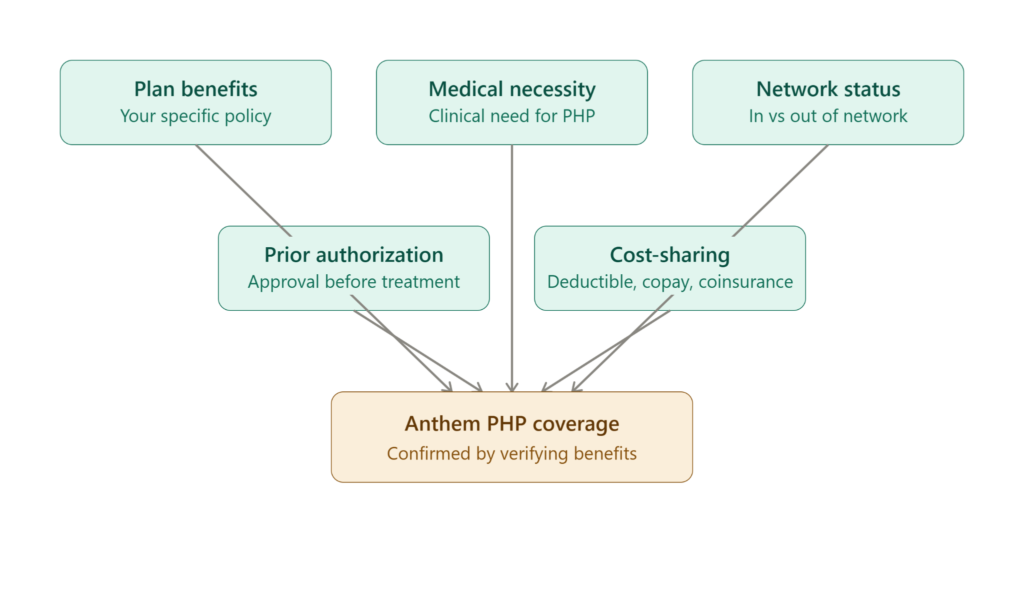
The short answer is that Anthem plans may cover PHP for mental health when the treatment is considered medically necessary and meets the terms of your specific policy. But “may cover” is doing a lot of work in that sentence. Whether your plan actually pays for PHP and how much you’ll owe out of pocket depends on several factors: your specific plan, your clinical needs, whether the provider is in network, and whether prior authorization is required.
This guide walks through what determines Anthem PHP coverage, what it might cost, and exactly how to verify your benefits before you start treatment.
Key Takeaways
- Anthem may cover PHP for mental health, but coverage depends on your specific plan, medical necessity, and whether the program meets Anthem’s coverage requirements.
- Prior authorization may be required before starting PHP, so verify benefits and approval requirements with Anthem before treatment begins.
- Out-of-pocket costs can vary based on your deductible, copay, coinsurance, network status, and the PHP provider you choose.
Does Anthem Cover PHP for Mental Health?
Q: Does Anthem cover PHP (partial hospitalization) for mental health?
A: Anthem plans may cover partial hospitalization programs for mental health when the treatment is considered medically necessary and meets the terms of the member’s specific plan. Coverage can vary based on the policy, diagnosis, provider network, and whether prior authorization is required. Before enrolling, contact Anthem or review your plan documents to confirm PHP benefits, authorization requirements, in-network providers, and expected out-of-pocket costs.
What Is PHP for Mental Health?
Partial hospitalization programming (PHP) is a structured, intensive form of mental health treatment. Patients attend treatment during the day, typically several hours, several days a week, and return home in the evening rather than staying overight.
A typical PHP may include the following:
- Individual therapy
- Group therapy
- Psychiatric evaluation or medication management, when appropriate
- Clinical monitoring
- Skills-based treatment
- Crisis and safety planning
PHP sits in a specific spot on the continuum of mental health care more intensive than routine outpatient therapy, but less restrictive than an overnight hospital or residential stay.
| Level of Care | Overnight Stay? | Typical Intensity |
| Outpatient therapy | No | Lower |
| IOP | No | Moderate |
| PHP | No | High |
| Residential | Yes | High |
| Inpatient | Yes | Highest / acute |
According to Medicare.gov, partial hospitalization is a structured program of outpatient psychiatric services that serves as an alternative to inpatient psychiatric care, typically involving four to eight hours of care each day.¹ Understanding where PHP fits matters because insurance coverage rules — including Anthem’s — often differ by level of care. Learn more about what a partial hospitalization program involves.
Does Anthem Cover PHP for Mental Health?
Anthem may provide coverage for medically necessary mental health PHP services under eligible plans. Anthem partial hospitalization coverage: Coverage is determined by your specific policy and your clinical circumstances, not by the Anthem name alone.
Several things typically factor into whether a claim is covered:
- Medical necessity
- Whether PHP is a covered behavioral health benefit under your plan
- Provider network status
- Authorization requirements
Two important nuances worth understanding up front: having Anthem insurance doesn’t automatically mean every PHP program or every service within a program is covered, and a provider accepting Anthem insurance doesn’t, by itself, guarantee payment for all services rendered.
Anthem may cover PHP for mental health when the service is covered under your plan and meets applicable medical-necessity and authorization requirements.
The most reliable way to know where you stand is to verify your benefits directly a step covered in detail below. See how PHP compares to other mental health treatment options.
What Determines Anthem PHP Coverage?
Your Specific Anthem Plan
Anthem offers many different plans, and benefits vary from one to the next. The name “Anthem” on your insurance card tells you who your insurer is it doesn’t tell you exactly what’s covered. Review your plan documents or member portal, or contact Anthem directly, to understand your specific behavioral health benefits.
Medical Necessity
“Medical necessity” refers to whether a treatment is clinically appropriate given your diagnosis, symptoms, and level of impairment. Insurers typically require documentation such as a clinical assessment or treatment recommendation to support that PHP is the appropriate level of care.
Note: Having a diagnosis and meeting medical-necessity criteria for PHP specifically are not necessarily the same thing. A clinical evaluation helps establish whether PHP cost with insurance, rather than a different level of care, is warranted.
Federal coverage guidance offers a useful reference point here: the Centers for Medicare & Medicaid Services notes that partial hospitalization is generally appropriate when a patient’s condition requires a level of intensity and frequency comparable to inpatient care, but the patient does not need 24-hour supervision and has enough support to remain safely at home between sessions. Private insurers, including Anthem, typically apply their own comparable medical-necessity criteria when reviewing PHP requests.
In-Network vs. Out-of-Network PHP Providers
Whether a PHP facility is in Anthem’s network can significantly affect both coverage and cost. In-network providers have negotiated rates with Anthem, which often means lower out-of-pocket costs for you. Out-of-network care may be covered differently or not at all depending on your plan. Always confirm network status directly with both Anthem and the provider before starting treatment. Find an in-network mental health provider.
Prior Authorization and Utilization Review
Some Anthem plans require prior authorization before PHP begins. Starting treatment without required authorization can leave you responsible for costs you expected insurance to cover.
Before Starting PHP, Ask These 5 Questions:
- Is prior authorization required for this program?
- Who is responsible for submitting the authorization request — you or the provider?
- How long does the authorization review typically take?
- What clinical documentation is needed to support the request?
- How long is the authorization valid once approved?
Many PHP providers will handle some or all of this process on your behalf, but it’s worth confirming rather than assuming.
How Much Does Anthem PHP Cost?
There’s no single, universal price tag for PHP, and there’s no one-size-fits-all Anthem copay. Your actual out-of-pocket cost depends on your specific plan and benefits.
What affects your cost?
- Your deductible (and how much of it you’ve already met)
- Copayment amounts
- Coinsurance percentage
- Your out-of-pocket maximum
- Whether the provider is in-network or out-of-network
- Which specific services are covered vs. excluded
The cost of PHP can also vary by provider and by which services are bundled into the program. Because costs vary so widely, a formal benefits verification — rather than an estimate based on someone else’s experience — is the most reliable way to understand what you’ll owe. When possible, ask your provider for a written cost estimate before starting treatment. Explore more on mental health treatment costs.
How to Verify Anthem Coverage for PHP Before Treatment
Step 1: Check Your Anthem Plan Benefits
Start with your insurance card and plan documents. Look for behavioral health or mental health benefits, and check whether PHP or “partial hospitalization” is specifically addressed.
Step 2: Contact Anthem
Call the member services number on your insurance card, or use Anthem’s official member resources. Ask whether PHP is a covered benefit, whether it’s subject to medical-necessity review or prior authorization, and what your in-network versus out-of-network benefits look like.
Step 3: Ask the PHP Provider to Verify Benefits
Ask the facility whether they work with Anthem, and request a formal insurance benefits verification. Confirm what information they need from you and whether they’ll handle prior authorization. Keep in mind that a benefits verification is not always the same as a guarantee of payment.
Step 4: Confirm Your Expected Out-of-Pocket Cost
Ask about your deductible status, copay or coinsurance, and whether the provider is in-network. Also ask whether there are separate charges for evaluations, medication management, labs, or other services — and request a good-faith estimate or written cost breakdown when available.
Best practice: Verify coverage with both Anthem and the PHP provider not just one or the other.
Get a deeper walkthrough of verifying mental health insurance benefits.
What If Anthem Denies PHP Coverage?
A denial doesn’t necessarily mean treatment is clinically inappropriate — it means the claim, as submitted, didn’t meet the insurer’s criteria as written. If you receive a denial, it’s worth understanding your options.
If Your PHP Claim Is Denied:
- Review the stated reason for the denial carefully.
- Ask whether the decision can be reconsidered or appealed.
- Note any appeal deadlines.
- Find out what additional documentation may be required.
- Ask whether your provider can submit additional clinical information to support the appeal.
Work with your healthcare provider and Anthem to understand what’s available to you. In some cases, your treatment team may also discuss whether an alternative level of care is clinically appropriate. This isn’t legal advice, and an appeal isn’t guaranteed to succeed — but understanding the process gives you options. Learn more about what to do if insurance denies mental health treatment.
What to Do Next If You’re Considering PHP
- Talk to your treatment provider about whether PHP is the appropriate level of care for your situation.
- Contact Anthem to confirm your benefits and authorization requirements.
- Ask the PHP provider to verify your insurance benefits directly.
- Confirm network status and expected costs before you commit to a start date.
Above all, prioritize clinical appropriateness — choose the level of care that fits your needs first, then work through the insurance details. Find a mental health treatment program.
Conclusion
Anthem may cover PHP for mental health treatment, but individual coverage varies based on your specific plan benefits, medical necessity, and authorization and network requirements. The most important step you can take is to verify your coverage with both Anthem and your prospective First City Mental Health Center before treatment begins.
Verify Your Insurance Coverage for PHP
Insurance coverage varies by plan. Please confirm your specific benefits directly with Anthem and your treatment provider before beginning care.
Frequently Asked Questions
Does Anthem require a referral before starting PHP?
It depends on your specific plan. Some Anthem plans require a referral from a primary care provider or mental health professional before PHP is approved, while others allow direct admission based on a clinical assessment from the PHP provider. Check your plan documents or call Anthem member services to confirm whether a referral applies to you.
How long will Anthem cover PHP treatment?
There’s no fixed length of coverage that applies to every member. Anthem typically bases continued coverage on ongoing medical necessity, which is often reviewed periodically throughout treatment. Your treatment team may need to submit updates showing that PHP remains clinically appropriate for coverage to continue.
Does Anthem cover PHP for co-occurring mental health and substance use conditions?
Anthem may cover PHP for co-occurring, or dual-diagnosis, treatment when the program is equipped to address both conditions and the service meets medical-necessity and plan requirements. As with any PHP claim, coverage depends on your specific plan and clinical documentation, so it’s worth confirming this directly with Anthem and the provider.
Does Anthem cover virtual or telehealth PHP programs?
Some Anthem plans cover telehealth-based PHP, while others may limit coverage to in-person programs or apply different rules to virtual care. Availability also depends on state regulations and the specific program’s licensing. Ask Anthem whether your plan includes telehealth PHP benefits before enrolling in a virtual program.