

Signs It’s Time to Get Mental Health Treatment (Not Just Therapy Once a Week)
August 14, 2026
Therapy, IOP, PHP, Inpatient: The Levels of Mental Health Care Explained
August 19, 2026

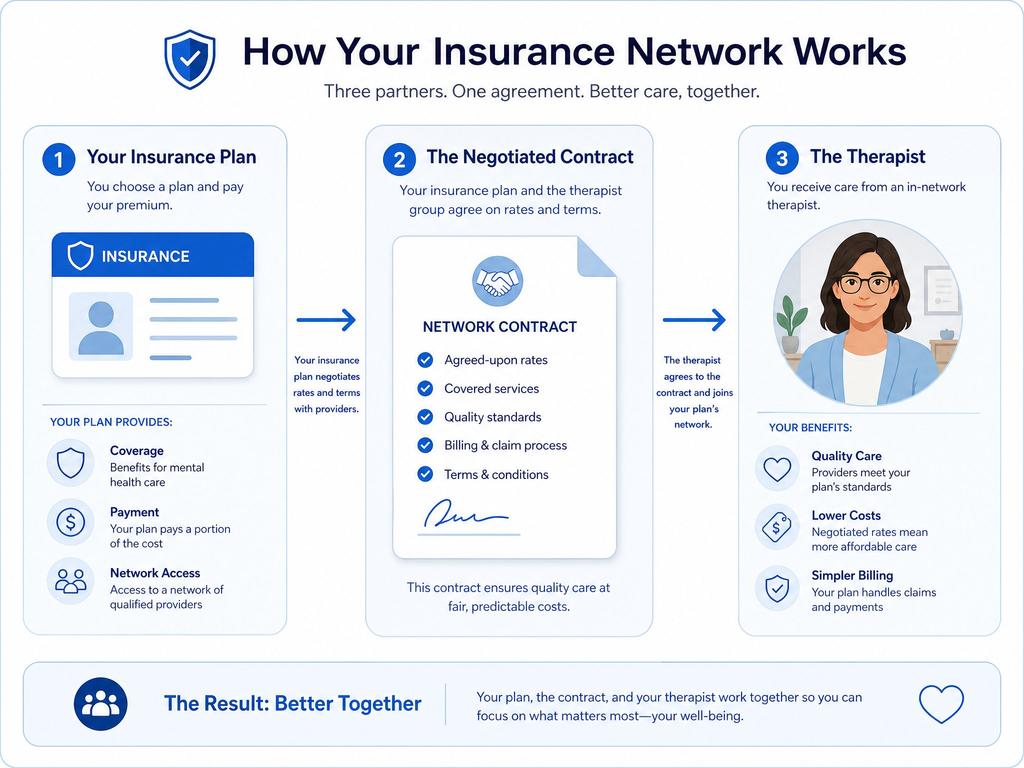
Insurance jargon has a way of making a simple question feel like a legal exam: What does in-network mean for mental health? You call a therapist’s office, ask if they take your plan, and the receptionist says “we’re in-network with Anthem.” Great. Except that sentence tells you almost nothing about what you’ll actually owe. In-network, for mental health care, means the provider has signed a contract with your insurance company (say, Anthem Blue Cross or Blue Shield) agreeing to accept a negotiated rate for covered services.
That contract is the whole ballgame. It determines what the insurer pays, what you pay, and whether you’re protected from balance billing. But signing that contract doesn’t erase your deductible, your copay, or your coinsurance. Network status and cost are related. They’re not the same thing.
Key takeaways:
- “In-network” means a mental health provider has a direct contract with your specific insurance plan, not just a general relationship with the insurance company.
- Network status can lower your share of the bill, but it does not guarantee free care. Deductibles, copays, and coinsurance still apply depending on your plan.
- Verifying benefits before your first appointment (with both the provider’s office and your insurer) is the only reliable way to avoid a surprise bill later.
Does an in-network therapist always cost less than an out-of-network one?
Question: Does an in-network therapist always cost less than an out-of-network one?
Answer: Usually, yes, because the negotiated rate caps what you’re charged and shields you from balance billing. But “usually” isn’t “always,” and plenty of people with generous out-of-network benefits end up paying close to the same amount either way. Check your plan before assuming.
What “In-Network” Actually Means
An insurance network is basically a roster. The insurer builds a list of therapists, psychiatrists, psychologists, and treatment centers who’ve agreed, in writing, to accept a set reimbursement rate in exchange for a steady stream of referrals. That’s it. That’s the whole mechanism.
Here’s where people get tripped up, though. A provider can be in-network with one Anthem plan and completely out-of-network with another Anthem plan. Same insurance company, different contract. So when a front desk person tells you “we take Anthem,” ask the follow-up question: which specific plan, and which network tier? “Accepts your insurance” and “is in-network for your exact policy” are not interchangeable phrases, even though they get used that way constantly.
I’d treat any provider website that just says “we accept most major insurances” with a healthy dose of skepticism for in-network vs. out-of-network mental health until you’ve confirmed it yourself.
Think of it in three links: your plan, the provider’s network agreement, and the specific mental health service you’re seeking. Break any one of those links and your cost picture changes.
Why Network Status Matters for Your Bill
Network status touches almost every cost variable on your explanation of benefits. It affects the amount your insurer recognizes as the “allowed amount” for a session, your copay, your coinsurance percentage, whether your deductible even applies to behavioral health visits, and whether the plan offers out-of-network benefits at all.
Picture two people, both seeing a licensed clinical therapist for weekly sessions. Person A has an in-network provider under a plan with a flat $30 mental health copay. Person B loves their therapist but that therapist is out-of-network, and Person B’s plan has a $2,500 deductible plus 40% coinsurance after that. Same diagnosis, similar sessions, wildly different bills. That’s not a hypothetical dreamed up to scare anyone. It’s just how cost-sharing structures work when one side of the transaction has a contract and the other doesn’t.
In-Network vs. Out-of-Network Mental Health Care
Out-of-network doesn’t automatically mean “not covered.” Some plans still reimburse a portion of out-of-network therapy, particularly PPO plans. Others, especially HMO or narrow-network plans, offer little to nothing. The only way to know is to check your specific summary of benefits document, not guess based on what a friend’s plan does.
| Factor | In-Network | Out-of-Network |
|---|---|---|
| Provider has plan agreement | Usually yes | Usually no |
| Negotiated rate applies | Generally yes | Often no |
| Patient cost-sharing | Depends on plan | Can be higher |
| Deductible | Depends on plan | Depends on plan |
| Out-of-network benefits | Not relevant | Depends on plan |
| What to verify | Network status + benefits | OON coverage + reimbursement rules |
Actual costs vary by insurance plan, so treat this table as a framework, not a quote. And cost shouldn’t be the only lens here. If an out-of-network psychiatrist has genuine experience treating your specific trauma history or a rare co-occurring diagnosis, that clinical fit might be worth paying more for. A cheaper session with a mismatched provider isn’t really a bargain.
Does In-Network Mean Your Therapy Is Free?
No. This is probably the single biggest misconception in behavioral health billing, and it deserves to be said plainly.
Myth: “My therapist is in-network, so I won’t pay anything.” Reality: You may still owe a copay, coinsurance, or the full negotiated rate until you hit your deductible.
Network status and benefit coverage are two separate questions. Network status asks whether the provider has a contract with your plan. Benefit coverage asks what your plan actually pays for and how much you owe after that. A provider can be perfectly in-network and you can still get billed $150 for a session because your deductible hasn’t been met yet. That’s not a billing error. That’s just how most commercial health plans structure behavioral health care.
What Determines How Much You’ll Actually Pay
A handful of variables stack on top of each other to produce your final bill:
- Your deductible. Some plans apply mental health visits to a shared medical deductible; others carve out separate rules. Until that deductible is met, you may owe the full negotiated rate.
- Copay or coinsurance. A copay is a flat dollar amount per visit. Coinsurance is a percentage of the allowed charge. Don’t assume which one applies to your plan until you’ve checked.
- Your specific mental health benefit. Plans sometimes limit visit counts, require authorization for certain levels of care (residential treatment, for instance, or a structured addiction treatment program), or apply different cost-sharing to telehealth versus in-person sessions.
- The provider and the billed service. A licensed therapist billing a standard 45-minute session and a psychiatrist billing a medication management visit can trigger different reimbursement codes entirely, even under the same plan.
How to Check Whether a Therapist Is In-Network
Directories lie more often than anyone would like to admit. Research on so-called ghost networks has repeatedly found provider listings that are outdated, duplicated, or simply wrong, according to analysis of provider directory challenges that tracked how often listed clinicians weren’t actually accepting new patients. Given that reality, verification has to happen on multiple fronts, not just one.
Start with the insurer’s own provider directory, but confirm the specific plan and network tier listed there, not just the company name. Then call the provider’s office directly and ask if they’re in-network for your exact plan, not just whether they “take” the insurer generally.
Finally, call your insurer like Anthem in-network mental health and ask a short, specific list of questions: Is this provider in-network for my exact plan? Is this type of visit covered? What’s my copay or coinsurance? Does my deductible apply? Do I have out-of-network benefits? Do I need a referral or prior authorization? Do this shortly before your appointment, since network rosters change more often than people expect.
What If the Therapist You Want Is Out-of-Network?
Don’t assume you have to walk away. Some plans still reimburse a chunk of an out-of-network claim, and many providers offer a self-pay rate that’s lower than their billed charge would suggest. Ask the office directly what that rate looks like, and compare it honestly against your expected in-network cost. If the provider is a strong clinical match, that gap might be worth it.
Federal law also plays a role here: the Mental Health Parity and Addiction Equity Act requires that financial requirements and treatment limits for behavioral health be no more restrictive than those applied to medical and surgical benefits, which is part of why out-of-network mental health coverage exists at all on many plans.
Data backs up just how common this out-of-network detour actually is. Patients are reportedly ten times more likely to seek out-of-network psychological care than they are for a comparable specialty medical visit, and separate reporting has found that patients in most U.S. counties struggle to find in-network mental health providers at all. So if you’ve hit a wall trying to find in-network care, you’re not doing anything wrong. The network itself is often just thin.
The Bottom Line
“In-network” describes a contract between a provider and your plan, nothing more, nothing less. It can meaningfully lower your share of the cost, but it doesn’t erase your deductible or guarantee a free visit at First City Mental Health Center. The safest move is boring but effective: verify network status and benefits before you book, not after the bill arrives.
If cost is genuinely standing between you and care, ask about sliding-scale options, self-pay rates, or programs at a treatment center that work directly with clients on affordability. Don’t let confusing terminology be the reason you delay care you actually need.
Frequently Asked Questions
1. What does “in-network” actually mean for mental health care?
“In-network” means the therapist, psychiatrist, or clinic has a contract with your specific insurance plan (e.g., Anthem Blue Cross PPO) to accept a pre-negotiated rate for covered services. That contracted rate—not the provider’s usual fee—is what you and your insurer split through your deductible, copay, or coinsurance.
2. If a therapist is in-network, why might I still owe a lot?
Being in-network lowers your cost but doesn’t erase your plan’s cost-sharing rules. You may still owe your full deductible first, then a copay (fixed amount) or coinsurance (percentage) for each session, and some services might not be covered at all.
3. How is in-network different from out-of-network for therapy or psychiatry?
In-network: you usually pay a predictable copay or coinsurance, the provider bills your insurer directly, and you’re protected from balance billing. Out-of-network: you often pay the full fee upfront, then seek partial reimbursement (if your plan has out-of-network benefits), and you can be billed for the difference between the provider’s charge and what your insurer allows.
4. What’s the difference between a copay, coinsurance, and deductible in mental health benefits?
A deductible is the amount you must pay out-of-pocket before your plan starts sharing costs. A copay is a fixed fee per visit (e.g., $25–$75) after the deductible is met. Coinsurance is a percentage of the allowed rate you pay after the deductible (e.g., 20% you pay, 80% the plan pays).
5. What questions should I ask before booking with an “in-network” mental health provider?
Ask: “Are you in-network with my exact plan name and product (not just the insurer)?” and “What will my cost be per session after my deductible—copay or coinsurance?” Also confirm whether they handle billing directly, whether any services require prior authorization, and what happens if your benefits change mid-year.
