

Intensive Outpatient Program for Mental Health in Indiana: How Our Adult IOP Works
October 7, 2026

You’ve been in weekly therapy for months, and the hour on Thursday afternoon isn’t holding the week together anymore. Or a therapist, an ER doctor, or someone in your family has told you that you need “a higher level of care,” and nobody explained what that means. That moment is common, and it’s often when people start comparing PHP vs IOP and the options around them.
The levels of mental health care run on a continuum of intensity: standard outpatient visits, intensive outpatient programs (IOP), partial hospitalization programs (PHP), residential treatment, and inpatient hospitalization. Inpatient and residential care mean you live at the facility. PHP, IOP, and outpatient treatment let you go home between sessions. This guide explains the difference between PHP and IOP, how the other levels fit around them, and how providers decide where someone should start. The right fit depends on a professional assessment, not an article like this one.
Key takeaways
- Levels of care measure structure and supervision, not success or failure. Needing more support is information, not a verdict.
- PHP typically runs 20 or more hours a week, while IOP typically runs 9 to 19 hours. Programs and payers vary.
- Care moves in both directions. People step up when symptoms worsen and step down after stabilizing.
What’s the difference between PHP and IOP?
Question: What’s the difference between PHP and IOP?
Answer: PHP is the more intensive of the two, often taking most of the day, five days a week, with regular psychiatric oversight. IOP is lighter, usually a few hours a day, a few days a week. Both let you go home at night.
What Are the Different Levels of Mental Health Care?
Think of the levels of mental health care as a dial. Turn it up and you get more treatment hours, more supervision, and more clinical support. Turn it down and you get more independence and flexibility. Higher doesn’t mean better. It means more support is available when you need it.
Here’s how the five settings compare. Treat it as a rough map, because programs differ on schedules, admission criteria, and who they serve.
| Level | Stay overnight? | Intensity | Typical time commitment | Main purpose |
| Inpatient | Yes | Highest, acute | 24 hours a day, usually days to a couple of weeks | Safety and stabilization |
| Residential | Yes | High | 24 hours a day, often weeks to months | Structured treatment and skill building |
| PHP | No | High | About 20 to 30+ hours a week | Intensive day treatment or step-down |
| IOP | No | Moderate to high | About 9 to 19 hours a week | More support than weekly therapy |
| Outpatient | No | Lower | Usually 1 to 2 hours a week | Ongoing treatment and maintenance |
Indiana’s system includes all of these: psychiatric hospitals, residential facilities, community difference between PHP and IOP, outpatient clinics, and mobile crisis units. Whether you’re in Indianapolis or a smaller city like Kokomo, the continuum exists. Access to each level is where it gets uneven, which is why it helps to know what you’re asking for before you call. The Indiana Family and Social Services Administration’s Division of Mental Health and Addiction oversees much of the public behavioral health system in the state.
Inpatient and Residential: Living at the Treatment Setting
Inpatient care
Inpatient care is hospital-based. You stay overnight, usually because someone needs round-the-clock monitoring, a rapid medication adjustment, or psychiatric stabilization. The work includes psychiatric evaluation, nursing care, medication management, therapy, and discharge planning. Stays are generally short because the goal is safety and stabilization, not a long course of therapy.
Inpatient care is typically reached through an emergency department or a crisis evaluation, not by calling ahead the way you would for other levels. It also provides useful context for the difference between PHP and IOP, since both allow you to return home rather than stay overnight.
Residential treatment
Residential treatment also means living on site, but the setting is a structured treatment home rather than a hospital unit. Stays often run weeks to months. Someone might land there because home is too destabilizing, or because symptoms are too disruptive for PHP or IOP but don’t require acute hospital care.
Are inpatient and residential interchangeable? No. Inpatient is built for crisis stabilization. Residential is built for sustained treatment and skill building in a supportive setting. Programs vary within each category, so ask each one what it actually provides day to day.
PHP: Most of the Day, Home by Night
A partial hospitalization program (PHP) is high-intensity day treatment. You arrive in the morning, spend five or six hours in group therapy, and do skills training such as DBT-style emotion regulation, medication check-ins, and individual or family sessions, then go home.
PHP is designed to be time-limited. It can follow an inpatient stay as a step-down, or in some cases take the place of an admission, provided the person can reliably stay safe outside the program. Federal Medicare guidance, for example, describes PHP as an alternative to inpatient psychiatric care and sets a threshold of roughly 20 hours of services a week. Someone at imminent risk of harming themselves or others doesn’t fit that model and needs a higher level of care.
A sample day might look like this: morning check-in, a skills group, lunch, an afternoon therapy block, then safety and discharge planning. Schedules vary, so don’t hold any program to that outline. If you want a fuller walkthrough, see our guide to what a day in PHP looks like.
Research supports the model. Studies of DBT-informed partial hospital and IOP care have found symptom reductions in depression and anxiety across both tiers, and work on virtual partial hospitalization suggests high-intensity daytime care can stabilize people quickly.
IOP: Real Support Without Pausing Your Life
An intensive outpatient program (IOP) sits between weekly therapy and PHP. Expect group therapy, some individual sessions, family work, and psychiatric services for roughly 9 to 19 hours a week. Many programs offer evening tracks, so people can keep working or attending school. SAMHSA’s clinical guidance on intensive outpatient treatment describes flexible scheduling as a real advantage of the model.
If you’re weighing a program against your work or school schedule, our guide to how IOP fits around a job covers the practical side.
PHP vs IOP: The Difference Between PHP and IOP Side by Side
The difference between PHP and IOP comes down to hours, focus, and how closely you’re monitored.
| PHP | IOP | |
| Typical hours | 20 to 30+ per week | 9 to 19 per week |
| Typical schedule | Most of the day, 5 days a week | A few hours a day, 3 to 5 days a week |
| Focus | Acute stabilization | Reintegration and relapse prevention |
| Psychiatric oversight | Frequent, often daily | Moderate, often weekly |
| Disruption to work or school | High | Low to moderate |
| Best suited for | Symptoms too severe for IOP but safe enough to go home at night | Real support while keeping work, school, or family routines |
When people compare PHP vs IOP, the instinct is often to pick the lighter schedule because it’s cheaper and easier to fit into a calendar. Insurers tend to lean that way too. But a lighter schedule only helps if it’s enough. When someone is significantly unstable, 9 to 19 hours a week may not provide the daily oversight they need, and being placed at too low a level can lead to dropping out of treatment or relapse.
The reverse matters equally. Over-treating isn’t a virtue either. A stable person in PHP can lose weeks they didn’t need to lose. The goal is the level that provides enough support, not the most or the least.
Outpatient Care and When It Stops Being Enough
Standard outpatient is the level most people know: you attend an appointment and go home the same day. Individual therapy, psychiatry, medication management, family therapy, and increasingly telehealth all live here. It is not the “lesser” option. For many people dealing with anxiety, mood disorders, or trauma, it’s exactly right, sometimes for years.
So how do you know it’s no longer enough? Usually through a pattern:
- Symptoms are worsening despite consistent treatment
- Daily functioning is slipping at work, school, or home
- Sleep and eating are falling apart
- Safety worries are creeping up
- A medication change needs closer monitoring than weekly visits allow
No single symptom automatically means a specific level. That’s the job of an assessment. For more on recognizing the shift, see signs weekly therapy may not be enough.
Which Level of Care Fits Your Situation?
Providers match a level to a person’s current safety, symptoms, and schedule. This is a general guide, not a diagnosis.
| If this sounds like you | A level a provider may consider | First City program |
| You are in immediate danger or cannot keep yourself safe | Emergency care or inpatient hospitalization | Call 911 or 988 first |
| You need 24-hour support or home is too destabilizing for treatment to work | Residential | Residential program |
| Symptoms are severe, but you can stay safe at home and can commit most of the day to treatment | PHP | PHP program |
| Weekly therapy isn’t enough, but you need to keep working, studying, or caring for family | IOP | IOP program |
| You’re stable and want ongoing support or maintenance | Outpatient | Outpatient program |
Treat the table as a starting point for a conversation with a clinician. Many people don’t fit neatly into one row, and the right starting level can change after an assessment.
How Providers Decide
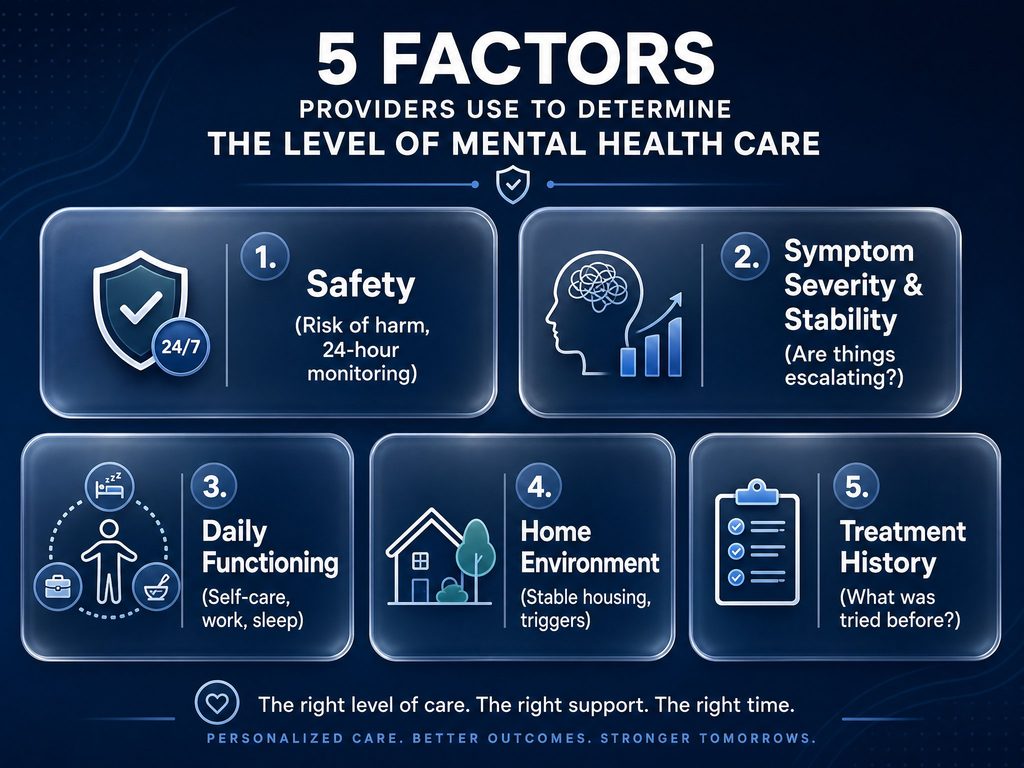
Providers don’t choose a level of care based on diagnosis alone. Clinicians consider several factors at once:
- Safety: Risk of harm, ability to follow a safety plan, and need for 24-hour monitoring.
- Symptom severity and stability: Whether symptoms are escalating and whether current treatment is working.
- Daily functioning: Self-care, work or school, sleep, eating, and managing medications.
- Home environment: Stable housing, supportive people, exposure to triggers, and transportation.
- Treatment history: What’s been tried, what helped, and whether a lower level of care was enough.
The home environment factor is easy to overlook. Someone with strong family support may be able to manage PHP from home, while someone in an unsafe or unstable environment may need residential care.
First City Mental Health Center in Kokomo, Indiana, offers residential, partial hospitalization (PHP), intensive outpatient (IOP), and outpatient programs, providing different levels of structure based on each person’s needs. Admission begins with a confidential clinical assessment of symptoms, history, and individual circumstances. That assessment is where a clinician confirms which level fits and where you should start. For more on what the process involves, see what happens at an intake assessment.
Care Moves Up and Down
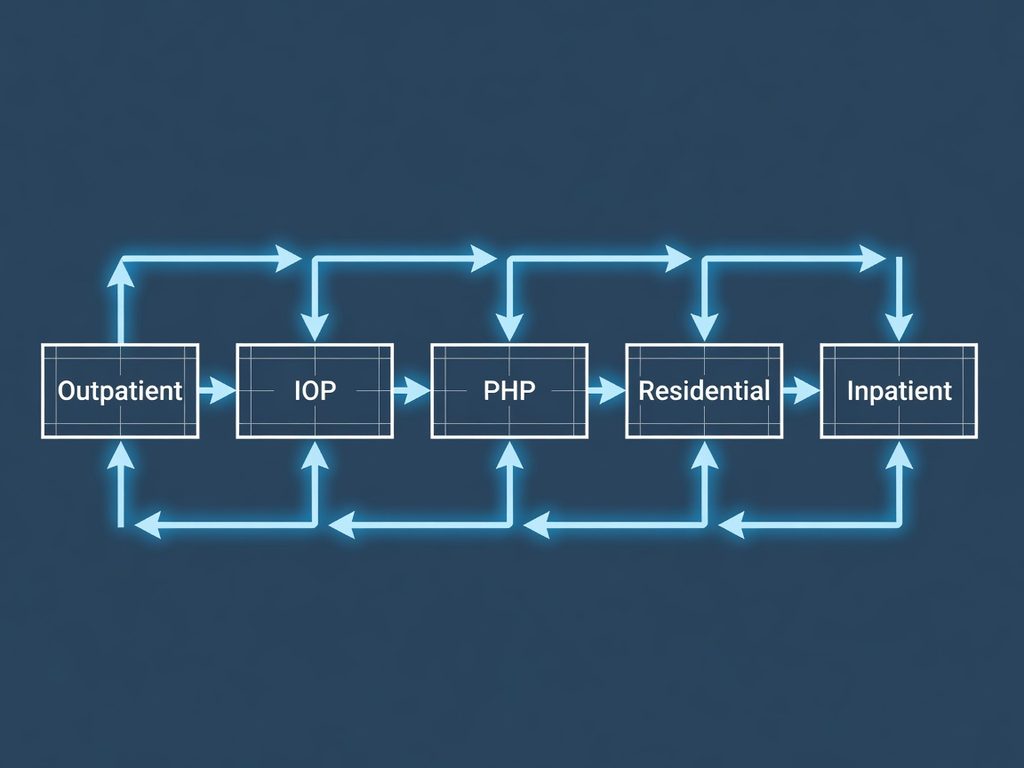
Nobody signs a lifetime contract with a level of care. A common path runs inpatient to PHP to IOP to outpatient. Another runs outpatient to IOP and, if things worsen, up to PHP or hospitalization. Plenty of people skip steps entirely.
Step-down matters most. Leaving a hospital straight to weekly therapy can feel like falling off a cliff. A short PHP stay, roughly two to four weeks, followed by IOP for a couple of months, softens that landing. Continuity between programs, meaning records are shared and care is coordinated, is what makes it work. If you’re planning for the weeks after a hospital stay, our guide to step-down care after hospitalization explains what to line up in advance.
Choosing a Program in Indiana
When you call a program, ask real questions:
- Which level of care do you provide, and how many hours a day and week?
- Do you offer psychiatric and medication management on site?
- What happens if symptoms get worse, and can you coordinate a higher level of care?
- What happens after discharge, and do you coordinate with my outside therapist or doctor?
- What insurance do you accept, and what are the admission requirements?
Indiana’s FSSA maintains provider information for community mental health centers, and you can also search nationwide using SAMHSA’s FindTreatment.gov. Many counties, Howard County among them, have local services worth checking, and Indiana 211 can point you to community resources. For education and peer support, NAMI Indiana offers programs for individuals and families. A program that dodges your questions is telling you something. For a longer checklist, see questions to ask before choosing a program.
Does Insurance Cover It?

Coverage differs by plan, service, and provider, and it can differ between levels too. Insurers tend to scrutinize PHP hardest, often requiring a medical necessity review showing that you’d likely need inpatient care if placed at a lower level. Expect to hear about prior authorization, in-network versus out-of-network, deductibles, and coinsurance. Call both your insurer and the program before starting.
Indiana Medicaid has its own behavioral health rules, and those shouldn’t be assumed to apply to a commercial plan. If you’re unsure which applies to you, the admissions team at a program can usually help you verify benefits.
When to Get Urgent Help
If someone is in immediate danger, call 911 or go to the nearest emergency department. For crisis support or emotional distress, call or text 988, the 988 Suicide & Crisis Lifeline. Don’t wait for a routine appointment.
Conclusion: Match the Level to Right Now
Five settings, one idea. Outpatient, IOP, PHP, residential, and inpatient each offer a different amount of structure, and the right one is whichever provides enough support while preserving as much independence as is safe. Not the highest. Not the cheapest. The fitting one.
Unsure? Request an assessment instead of guessing from a web page. First City Mental Health Center offers residential, PHP, IOP, and outpatient programs in Kokomo, with treatment options tailored to individual needs. Speaking with an admissions professional can help you understand your options and confirm the right starting level.
Ready to explore your options? Review the level-of-care comparison table above, then contact First City Mental Health Center to request a free clinical assessment.
Emergency first if safety is at stake, a professional assessment second, then a conversation with programs about what they offer. This article is educational and isn’t a diagnosis or treatment recommendation.
Frequently Asked Questions
What is the highest level of mental health care?
Inpatient care, which provides hospital-level acute psychiatric treatment and 24-hour monitoring. “Highest” refers to intensity, not quality.
Is residential treatment the same as inpatient?
No. Both involve overnight stays, but inpatient is hospital-based and focused on acute stabilization, while residential is a structured live-in setting outside an acute hospital.
What is the difference between PHP and IOP?
PHP is a higher-intensity day program, typically 20 or more hours a week with frequent psychiatric oversight. IOP is typically 9 to 19 hours a week with more flexibility for work or school. Both let you return home each night.
Can you go from outpatient therapy to PHP or IOP?
Yes. If symptoms or functioning worsen, a provider may recommend a more structured level.
How long do people stay in treatment?
There’s no universal timeline. Length depends on the level, clinical progress, safety, insurance requirements, and the program itself.
How do I know which level I need?
A qualified behavioral health professional should assess symptoms, safety, functioning, support system, and treatment history.