

Levels of Mental Health Care in Indiana: Inpatient, Residential, PHP, IOP and Outpatient Compared
October 5, 2026
IOP Near Me: Adult Intensive Outpatient Serving Kokomo and Howard County
October 9, 2026

You’ve been white-knuckling it. Weekly therapy helps for about a day and a half, then the dread creeps back in, and you’re still expected to show up for work, for your kids, for everybody. If that sounds familiar, an intensive outpatient program for mental health may be the missing middle. An IOP is structured treatment, several days a week, that lets you sleep in your own bed at night. At First City Mental Health Center in Kokomo, the adult program is built around that idea.
This page explains what our adult mental health IOP program involves: who it’s for, how treatment is structured, what a week looks like, how it compares with other levels of care, and how to start. If you’re still sorting out the differences among all the levels of care, our guide to the levels of mental health care in Indiana is a good place to begin.
Key takeaways
- An intensive outpatient program (IOP) gives you far more treatment contact than weekly therapy, without an overnight stay.
- It fits people who need real structure but can stay safe at home. It is not 24-hour supervision and not emergency care.
- Fit is decided by an individual clinical assessment, so the first step is a conversation, not a commitment.
What is a mental health IOP?
Question: What is a mental health IOP?
Answer: It’s a nonresidential program where you attend scheduled group and individual sessions several days a week, then go home and practice what you learned. Clinical guidance such as SAMHSA’s TIP 47 generally describes an IOP as at least nine hours of structured treatment per week.
Who an Adult IOP Is For

Weekly therapy can be incredibly valuable. But for some people experiencing moderate-to-severe distress, one hour a week isn’t enough support.
Think about the gap: one session on Tuesday, then six days of managing everything on your own. For someone whose symptoms are affecting work, relationships, parenting, sleep, or basic daily functioning, that gap can feel enormous. An adult mental health IOP program offers a different level of structure. You get more frequent support, you learn coping skills, you practice them with guidance, and you build momentum between sessions.
You might want to ask for an IOP evaluation if any of these sound familiar:
- Symptoms are spilling into everyday life. Depression, anxiety, mood symptoms, or emotional distress are affecting work, school, parenting, sleep, relationships, or routines.
- Weekly therapy feels like a bandage. Therapy is helping, but one session a week doesn’t feel like enough for what you’re dealing with right now.
- Things have gotten worse recently. You’re having a harder time steadying yourself or keeping up with responsibilities than before.
- You’re stepping down from a higher level of care. You’re leaving inpatient, residential, or another intensive setting and want structured support while returning to everyday life.
- You need accountability and practice. You don’t just want to talk about coping strategies. You want a place to learn, rehearse, and apply them.
This list is not a diagnosis.
Please don’t use the list above to diagnose yourself or decide whether an intensive outpatient program Indiana residents can access is right for you. Some people need less support than IOP. Others may need partial hospitalization, inpatient treatment, or emergency care. The right level depends on your symptoms, functioning, safety, treatment history, and individual needs. That’s why an assessment matters: a clinician can look at the full picture and determine whether IOP fits or whether another level of care would serve you better.
One clarification: this is mental health treatment
This page is about adult mental health IOP. A mental health intensive outpatient program is not the same thing as an opioid treatment program or treatment for opioid use disorder. “Intensive outpatient” is used across different areas of behavioral healthcare, so make sure you’re looking at the type of treatment that matches your needs. If you’re looking for structured support for depression, anxiety, mood symptoms, or other mental health concerns, the question to ask is whether an adult mental health IOP is an appropriate level of care for you.
How the Adult IOP Works, Step by Step
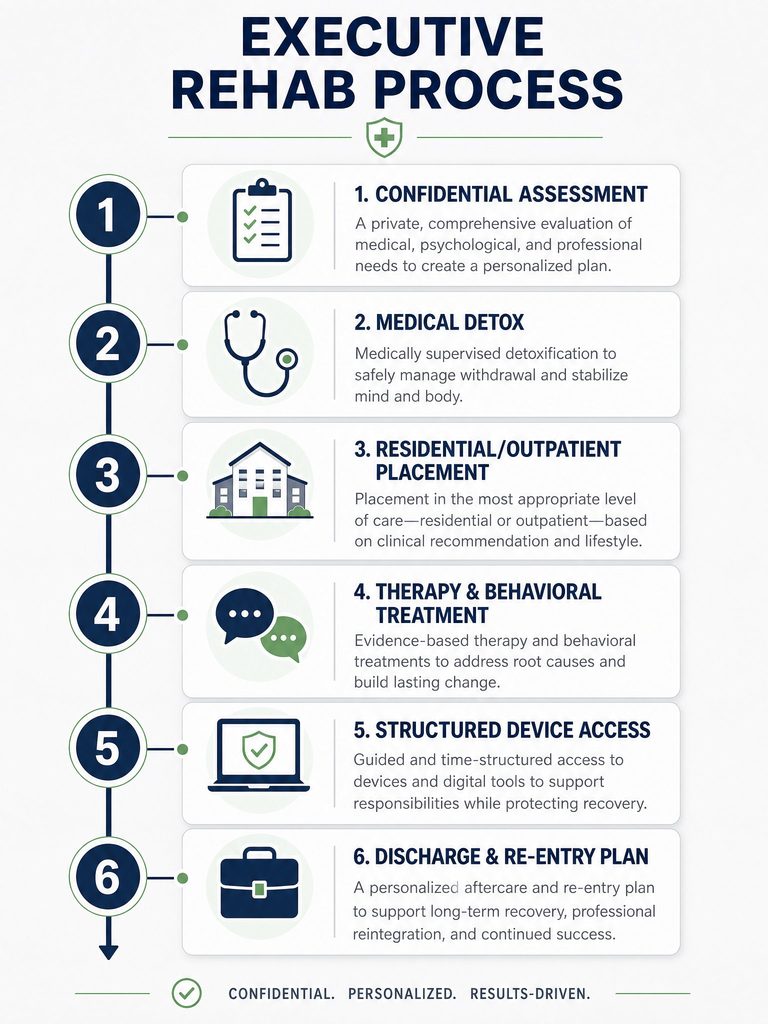
- Initial assessment. A clinician asks about symptoms, history, current functioning, past treatment, medications, safety, and what you want out of treatment. Substance use or medical issues come up when relevant. This is also where we decide whether IOP is the right level of care at all.
- An individualized treatment plan. Findings turn into goals tied to real life: less avoidance, calmer mornings, better communication at home.
- Structured treatment. Group therapy, individual counseling, psychoeducation, and skills work. Medication management and family involvement depend on what’s clinically appropriate and available, so ask about them at intake rather than assuming.
- Skills practice outside the building. This is the whole point of the model.
- Progress reviews. Your plan is reviewed along the way and adjusted when it needs to be.
Think symptom, then skill, then life. Panic spikes before Monday meetings (symptom). You learn grounding and paced breathing (skill). By week three, you use them in the parking lot before you walk in (life). That loop is why the intensive outpatient program Indiana works well for people who don’t need round-the-clock care: you practice cognitive behavioral therapy (CBT) or dialectical behavior therapy (DBT) tools in the exact places you’ll need them.
What a Typical Week Looks Like
At First City Mental Health Center, the adult IOP typically runs 3 to 4 days per week, with sessions of approximately 3 hours. Group work is the backbone, with individual sessions layered on. Your exact days and hours are confirmed during intake.
Ask the admissions team whether telehealth or evening options are available for your situation.
Can you keep working? Often, yes, but be honest with yourself: nine or more hours a week is real time. Parents, students, and shift workers can sometimes make it fit, though no program fits every calendar, and a good team will tell you plainly if it won’t. If scheduling is your main concern, ask about it on your first call.
IOP vs. Other Levels of Care
| Level | General structure | Lives at home? | Best starting question |
| Outpatient | Lower frequency, often weekly | Usually | Can weekly therapy meet my needs? |
| IOP | Structured, several days weekly | Usually | Do I need more support while staying in the community? |
| PHP | More intensive daytime care | Usually | Do I need a higher level of daytime structure? |
| Inpatient | 24-hour hospital care | No | Do I need immediate stabilization or continuous supervision? |
Partial hospitalization (PHP) is the heavier daytime option. It’s time-limited, doesn’t include 24-hour nursing, and requires that you can stay safe outside the program. If you’re weighing the two, see our comparison of PHP vs IOP. Inpatient and residential care are where you go when safety can’t be managed at home. Our residential treatment page explains that level.
Some programs are marketed as “basically inpatient,” and that framing deserves skepticism. You still go home after sessions, and that’s a feature. Research reviews suggest outcomes from intensive outpatient care can be comparable to higher levels of care for people who don’t need medical stabilization. Comparable for the right person, not for everyone.
What Conditions and Concerns It Targets
Programs should only list what they truly treat, so confirm specifics with the admissions team. Commonly, an adult IOP addresses depression, anxiety disorders and panic attacks, bipolar and other mood disorders, and trauma-related symptoms including PTSD.
Rather than chase labels, think function:
- Depression often shows up as lost routines and motivation, so treatment leans on behavioral activation and structure.
- Anxiety means avoidance and worry, so you build coping skills and, when appropriate, exposure-based strategies.
- Mood instability calls for emotional regulation, mindfulness, and monitoring.
Nobody gets “cured” in an IOP. You get tools, structure, and momentum. That’s a big difference.
How Long Does IOP Last?
It depends on clinical need, progress, goals, and insurance authorization. Anyone quoting you a fixed number of weeks before meeting you is guessing. Treatment usually moves from starting, to building skills, to reviewing progress, to stepping down. Finishing should mean you have a next step, not that the door simply closes.
After IOP, and the Safety Note
Before you leave, make sure you know:
- Who provides your ongoing care, and when the next appointment is
- Which medication or treatment recommendations need follow-up
- What warning signs mean you should get more help
- Who to call in a crisis
Common next steps include standard outpatient therapy, psychiatry, primary care coordination, and support groups such as those offered through NAMI Indiana. If symptoms climb again, stepping back up isn’t failure. For more on what comes next, see our page on outpatient care after IOP.
IOP is not emergency care. If you or someone you love is in immediate danger, call 911 or go to the nearest emergency room. For crisis support, call or text 988, the 988 Suicide & Crisis Lifeline, available 24/7. Don’t wait for an intake slot.
Is It Right for You? Getting Started
You may be a strong fit if you need more structure than weekly therapy, can safely live in the community, are willing to participate actively in treatment, and have symptoms that are affecting daily life. If you need constant supervision or immediate stabilization, a higher level of care may be more appropriate.
Why Choose First City Recovery Center
A generic directory listing tells you little about a provider. Here’s what to know about us before you call:
- Accreditation: First City Recovery Center is accredited by The Joint Commission, and its Kokomo listing includes intensive outpatient services. You can verify accreditation on the Joint Commission’s Quality Check site.
- Locations: 317 W. Jefferson St. and 310 W. Taylor St., Kokomo, IN 46901.
- Typical IOP schedule: 3 to 4 days per week, approximately 3 hours per session. Your specific schedule is confirmed during intake.
- Insurance: We accept most commercial plans. Listed plans include UnitedHealthcare, Anthem, Cigna, Magellan, Beacon, TRICARE, VA Community Care, Humana, and Aetna. Coverage should be verified before treatment, and our admissions team can help check your benefits. Indiana’s Medicaid program has its own behavioral health rules, so don’t assume commercial-plan details apply to it.
- What to bring: Insurance information, a current medication list, and relevant treatment history.
- What happens next: An assessment determines whether IOP is an appropriate level of care. There’s no promise of admission.
If you want to compare programs beyond ours, SAMHSA’s FindTreatment.gov lets you search by location.
Conclusion
IOP sits between “one hour a week isn’t cutting it” and “I need a hospital.” If your symptoms are affecting daily life, you need more structure, support, and accountability than traditional outpatient therapy provides, and you can safely continue living in the community, an adult mental health IOP program may be worth exploring. You don’t have to decide on your own whether it’s the right level of care. An assessment can help clarify what kind of support makes sense for you.
Ready to take the next step? Request a same-week IOP assessment, or ask our admissions team to verify your benefits before you commit. Call First City Mental Health Center at or use our online contact form. You can also learn more about First City’s IOP.
Frequently Asked Questions
Can I live at home during an IOP?
Generally yes. IOP is nonresidential, though suitability depends on your clinical circumstances and safety.
How many days a week is a mental health IOP?
Programs vary, usually several days weekly for a few hours at a time. At First City, the typical schedule is 3 to 4 days per week, and your intake confirms the actual schedule.
How long does an adult IOP last?
It varies with clinical need, progress, and coverage requirements, and intensity often tapers as you step down.
Is IOP the same as inpatient treatment?
No. Inpatient means overnight, 24-hour supervision. IOP means scheduled sessions, then home.
Does insurance cover a mental health IOP in Indiana?
Coverage depends on your plan, medical necessity, authorization rules, and provider status. Verify benefits before you start, and ask the team to help check them.