

Intensive Outpatient Program for Mental Health in Indiana: How Our Adult IOP Works
October 7, 2026
Adult IOP Programs Near Me: What to Look For and What We Offer
October 12, 2026

Searching “IOP near me” at 11 p.m. usually means something has gone sideways. Maybe a relapse. Maybe a spiral that weekly counseling can’t catch anymore. Whatever brought you here, you probably need to know one thing: can an adult intensive outpatient program in Kokomo or Howard County hold you up while you keep living at home and keep your job?
An intensive outpatient program (IOP) is a structured level of care between routine counseling and a hospital-style setting. You attend scheduled treatment sessions several days a week, then go home. First City Recovery Center Kokomo offers adult outpatient treatment in the Kokomo and Howard County area, and this page covers where it is, what attending looks like, who it fits, and how to start.
At a glance
- Location: 317 W. Jefferson St. and 310 W. Taylor St., Kokomo, IN 46901
- Typical schedule: 3 to 4 days per week, about 3 hours per session. Your exact schedule is confirmed at intake.
If you are in immediate danger tonight, call 911 or call or text 988. IOP can wait. Safety can’t.
Key takeaways
- IOP is a middle gear. It gives you more structure than standard outpatient care, and you still sleep in your own bed.
- Placement is a clinical decision. An assessment, not a search result, determines whether an adult IOP in Kokomo is the right level of care.
- Ask before you enroll. Schedules, insurance, and treatment focus differ between programs, so verify them directly.
Is IOP the same as rehab?
Question: Is IOP the same as rehab?
Answer: Not quite. “Rehab” is a loose label covering detox, residential care, and outpatient work. IOP is one outpatient level in that range, and it assumes you can stay safe at home between sessions.
Can You Actually Get There? Location, Hours and Drive Time
Proximity decides whether treatment sticks. A program you can reach after work is one you’re more likely to finish.
| Starting point | Approximate drive time | Notes |
| Downtown Kokomo | 3 to 5 minutes | Easy to reach on a lunch hour or straight after work |
| Elsewhere in Kokomo | 5 to 15 minutes | Varies by neighborhood and traffic |
| Russiaville | About 15 minutes | Drive east on State Road 22 |
| Greentown | About 15 to 20 minutes | Drive west on State Road 22 |
Drive times are estimates and can run longer during rush hour, so check your own route in a maps app before your first visit.
Parking and arrival: Ask the admissions team where to park and which entrance to use when you call, so you know before your first visit. If you need accessible parking or entrance information, mention it on the same call.
Hours: Call admissions to confirm current hours and IOP session times. The typical schedule is 3 to 4 days a week, about 3 hours per session, and your exact days and times are set at intake. If you work days, ask whether an evening option is available for your situation.
Getting there without a car: If you rely on rides or public transit, tell admissions when you call. Transportation shouldn’t be the reason you miss a session, and it’s easier to plan for before you start.
So What Does an IOP Actually Do?

Think of weekly therapy as a check-in. An intensive outpatient program is more like a training camp you commute to. If you’re searching for an intensive outpatient program near me, you’ll typically find that participants attend group counseling, some individual sessions, and skills education across several days a week, with hours that vary by program. There’s no universal schedule, so be cautious of any source that promises a specific number of weekly hours without accounting for the program and the treatment plan.
Programs can focus on substance use disorders, mental health, or both at once (co-occurring). Some use evidence-based approaches such as DBT, which teaches emotional regulation, mindfulness, and coping skills. Others center on relapse prevention and trigger planning. Clinical guidance such as SAMHSA’s TIP 47 on intensive outpatient treatment describes outpatient intensity as workable for people who don’t need 24-hour medical care.
That last clause carries a lot of weight, which brings up the question of fit.
Is This the Right Level of Care for You?
Many people guess wrong here. Some assume that if things feel terrible, they need residential care. Others assume that if they’re still showing up to work, they must be fine. Neither instinct is reliable, which is why a clinician performs an assessment.
IOP may fit when you:
- Need more structure than weekly appointments can offer
- Are medically and psychiatrically stable enough to be treated outside a facility
- Want to keep up with family, work, or school while getting help
- Are stepping down from residential care or partial hospitalization (PHP)
- Need extra support after a relapse or a rough stretch of symptoms
A higher level of care may be needed if you’re in immediate danger to yourself or others, acutely intoxicated or in withdrawal needing medical supervision, medically unstable, or in need of round-the-clock monitoring. If that’s you tonight, call 911, call or text the 988 Suicide & Crisis Lifeline, or go to the nearest emergency room. For substance use questions at any hour, SAMHSA’s National Helpline is free and confidential at 1-800-662-4357.
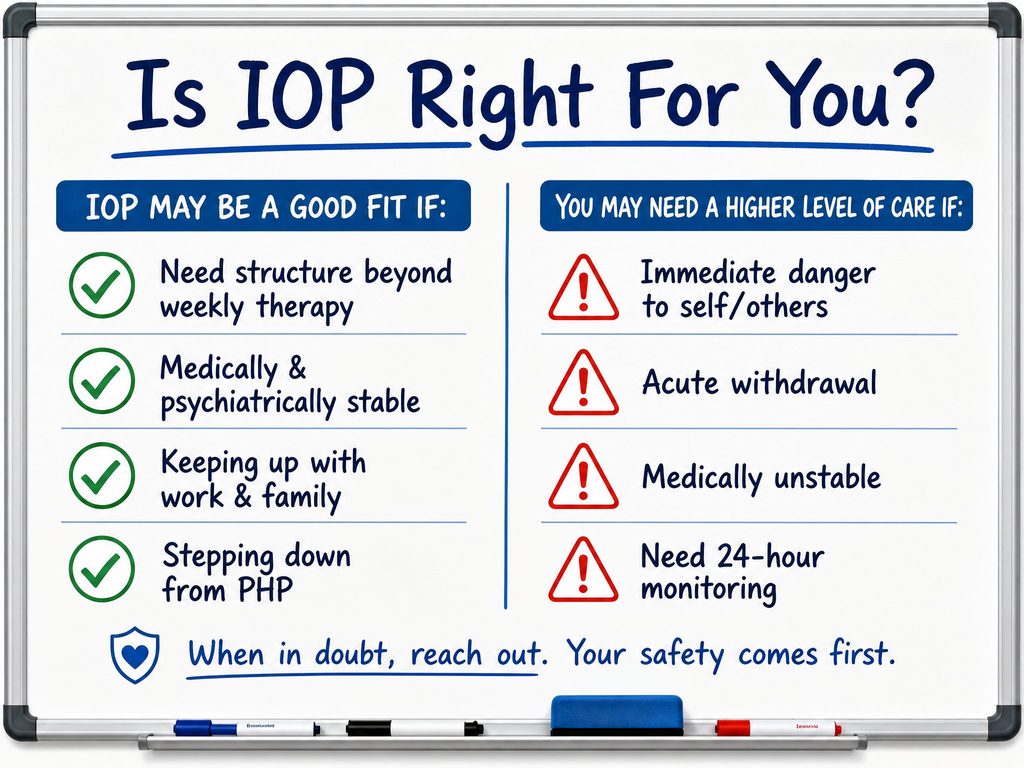
Final placement always comes from a professional. You can request an adult IOP assessment and let a qualified clinician sort it out with you.
How IOP Compares With Outpatient, PHP and Residential
The names blur together, so here is the side-by-side.
| Level of care | Living arrangement | General intensity | Best question to ask |
| Outpatient | Home | Lower | Can I manage with less structure? |
| IOP | Home | Moderate to high | Do I need regular structured treatment but can live at home? |
| PHP | Home | High | Do I need treatment for much of the day? |
| Residential | Treatment setting | Highest | Do I need 24-hour structure and support? |
Exact services and schedules vary by provider. A PHP at one hospital can look quite different from the same label elsewhere, so ask for specifics. Outpatient is lighter, PHP often fills most of a day, and residential means you live there. IOP is the one that lets life keep moving while you work on it. To see how all the levels fit together, read our guide to the levels of mental health care in Indiana.
What Treatment May Look Like in Kokomo
Programs differ, and the specific therapies offered should always be confirmed with the provider. Most adult IOPs follow a consistent rhythm:
- Initial assessment. A clinician reviews your history, symptoms, substance use, and safety, then recommends a level of care.
- Treatment plan. Goals are written down, and they’re yours, not a template’s.
- Active treatment. Group therapy, individual counseling, behavioral health education, coping skills, and relapse prevention. Family involvement and medication management or coordination may be included where offered.
- Progress review. The clinical team checks in, adjusts the plan, or steps you up or down in intensity.
- Discharge and continuing care. A real exit plan, ideally with outside providers looped in.
If you’re searching for IOP therapy near me and want to know what the weeks will look like, ask the admissions team to walk you through a typical session. If your main concern is depression, anxiety, or mood symptoms, our page on the adult mental health IOP explains that program in more detail.
Who Adult IOP Can Help
Picture a few examples. They are examples, not diagnoses. A man in his thirties finishes thirty days of residential care and feels wobbly the moment he’s back in his own kitchen. A woman keeps relapsing between weekly sessions and knows it. Someone with anxiety and drinking tangled together can’t untangle them alone.
Those are the situations adult IOP tends to address: substance use, co-occurring needs, step-downs from a higher level, and recovery needs that outgrow routine counseling. If a program only treats one area, it should say so plainly. Teens and adolescents generally need separate programming, so confirm the program is built for adults.
Why Choose a Program Close to Home
Distance affects consistency, especially when treatment involves appointments several days a week. For adults in Kokomo and Howard County, a nearby location makes it easier to attend sessions, stay connected with family and support networks, and keep continuity as treatment progresses. A shorter commute also leaves room for work and family.
First City Recovery Center provides adult treatment services in Kokomo. Service availability can vary by program and location, so contact the admissions team to confirm that your community is within the service area.
How to Choose a Program
Rather than hunting for the “best IOP near me,” which no one can honestly crown, ask questions. Copy these into your notes:
- What conditions does the program address?
- Is it designed specifically for adults?
- What does a typical week look like?
- How is the level of care determined?
- What happens at the initial assessment?
- Which clinicians provide treatment?
- Are group and individual sessions both offered?
- How is medication handled, if at all?
- Does the program coordinate with outside providers?
- Which insurance plans or payment options are accepted?
- What if I need a higher level of care?
- What does continuing care look like afterward?
Patients’ accounts are useful too. Some people say the group format is the most powerful piece, while others find certain curricula generic. Both reactions are real, so ask how individualized the treatment plan is. To compare options beyond one provider, you can search by location on SAMHSA’s FindTreatment.gov, and you can verify a program’s accreditation through the Joint Commission’s Quality Check.
Insurance, Cost and Admission
Coverage varies by plan. Many programs will verify benefits before admission, and some accept self-pay arrangements. Ask whether prior authorization is required, whether an assessment comes first, and what scheduling looks like. Cost matters, but it shouldn’t be the only thing steering your level of care.
Before enrolling, ask: Will you verify my insurance? What’s my out-of-pocket estimate? Is there a waitlist? If you’re covered through Indiana Medicaid, confirm that the program accepts it, since Medicaid has its own behavioral health rules.
Getting Started
- Contact the program.
- Complete a screening.
- Talk through your needs and goals.
- Confirm eligibility, insurance, and schedule.
- Begin the recommended care.
- Review progress and plan for what comes after.
Reaching out doesn’t lock you into anything. A phone call costs a few minutes.
Take the Next Step Toward Structure
IOP can give eligible adults real structure without pulling them out of Kokomo life. Don’t self-diagnose, though. Let an assessment tell you where you belong, and if the answer is a higher level of care, that’s information, not failure.
Ready to check the schedule? Review the evening IOP options and call First City Recovery Center Kokomo to reserve a seat in the next cohort, or contact the admissions team to verify your insurance and ask about availability. You can also get directions to our Kokomo location.
Frequently Asked Questions
What does IOP stand for?
Intensive outpatient program. It’s a structured treatment level where you attend several scheduled sessions a week and live at home.
Is there an IOP near me in Kokomo?
First City Recovery Center offers adult outpatient treatment in Kokomo at 317 W. Jefferson St. and 310 W. Taylor St. Call admissions to confirm availability and your schedule.
Can I work while attending IOP?
Often, yes, though it depends on the schedule and your clinical needs. Some programs offer evening options, so ask what’s available.
Does IOP treat mental health and substance use?
That depends on the organization. Some focus only on substance use, others on mental health, and some on both. Ask for the exact scope.
How many days per week is IOP?
It varies by program and treatment plan. At First City, the typical schedule is 3 to 4 days per week, and your intake confirms the actual schedule.
How do I know if I need IOP?
A professional assessment determines it. Symptoms, safety, medical stability, and home environment all factor in.